AI that keeps thinking
when half the team goes dark.
Picture six computers working together on one conversation — like teammates sharing the load. Now picture three of them getting unplugged, jammed, or destroyed mid-sentence. With Mycelium, the conversation just keeps going.No pause. No restart. No "something went wrong." That's the breakthrough — and you can watch it happen in three seconds, just below.
Demo requests open your email app with a subject filled in. Send the email to discuss a time; selecting the link does not book a demo.
Three things you can verify.
Review the mechanisms in the public companion repository or request a 30-minute walkthrough.
Survives worker loss.
Substitute-on-failure dispatch at the per-token MoE expert dimension. When half the mesh becomes unreachable mid-token, the coordinator substitutes a zero vector for the missing expert and the dense MLP keeps producing. Output coherence degrades proportionally to loss, not catastrophically.
OpenAI-compatible chat endpoint.
Any client that speaks /v1/chat/completions works without code changes. The mesh is an implementation detail your operators never see — they get the same interface their tooling already targets.
Tamper-evident audit chain.
Each chat is recorded in a canonical-JSON ledger with an HMAC chain and RFC 3161 trusted timestamps. A replay package is available under an evaluation NDA for end-to-end chain verification by a 3PAO.
How zero-vector substitution works
Distributed inference frameworks don't document what happens when an inference worker becomes unreachable mid-token. Most options are catastrophic: hang, error, drop the request. Mycelium's coordinator substitutes a zero vector for the unreachable worker's experts and the dense MLP path keeps producing tokens. Output coherence degrades proportionally to loss.
Day-27 reduction-to-practice recorded 2026-05-08 with HMAC-chained tamper-evident evidence. Not in any chaos-engineering catalog. Not in MITRE's experiment-process methodology. Not in NIST SP 800-204.
Distributed adaptive AI mesh network
Predictive expert prefetching · cross-model style normalization · behavioral proof-of-inference verification
- › Substitute-on-failure dispatch on the per-token MoE expert dimension
- › HMAC-chained tamper-evident audit ledger over canonical-JSON
- › Behavioral fingerprinting + Merkle execution traces + economic reputation
- › Auditable replay package available under evaluation NDA
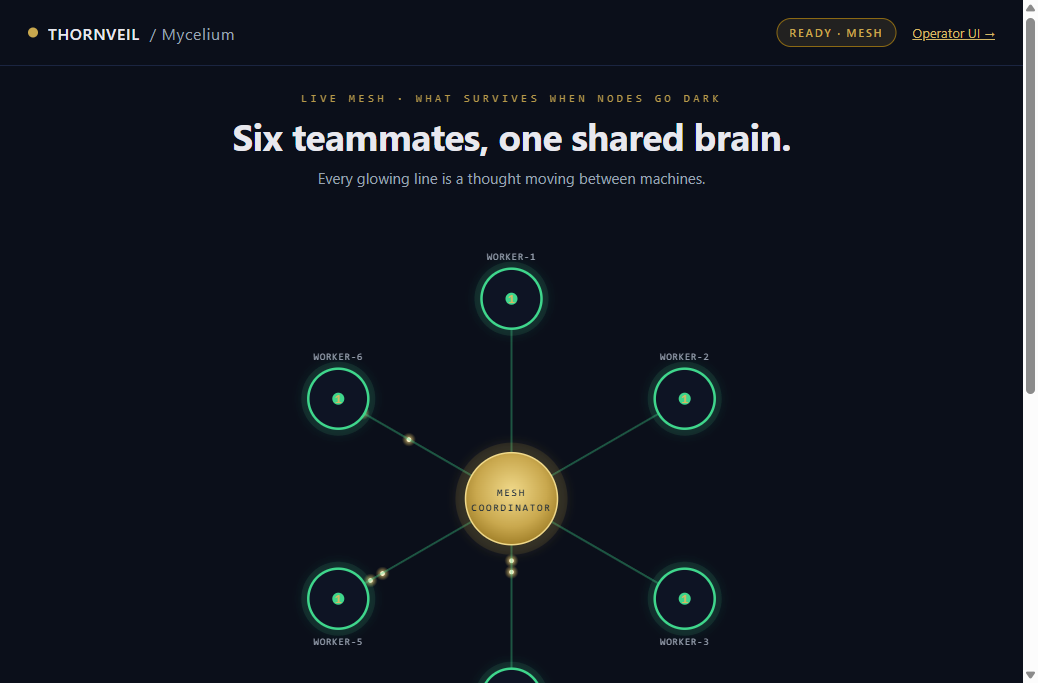
Same screen. Three seconds apart.
On the left: six computers, all green, working together on one answer. On the right: three are dead — and the answer isstill coming through. Nobody hit a button. Nothing was rerouted. The system simply kept going. Substitute-on-failure dispatch at the MoE expert dimension — not in any chaos-engineering catalog, not in MITRE, not in NIST SP 800-204.
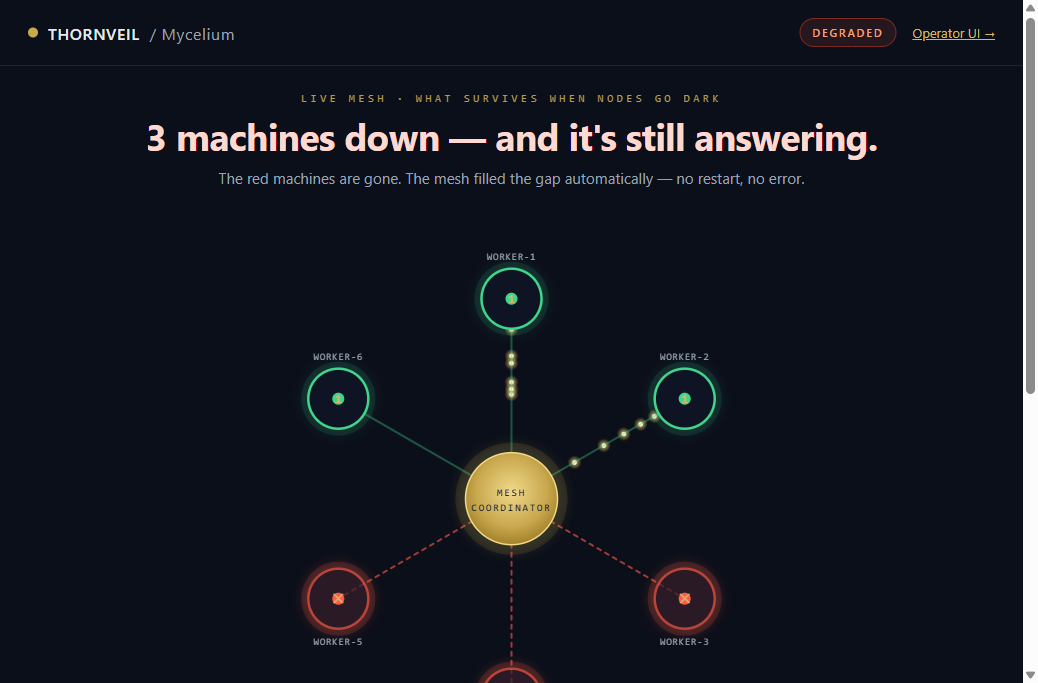
The user typing the question never noticed anything happened.
Filmed live · 2026-05-08 · HMAC-chained audit log · Replay package available under evaluation NDA
R2I-compliant by design.
"If you do not expose your interfaces and your documentation, you will not be able to join the ecosystem."
— Secretary of the Army Dan Driscoll · R2I hackathon announcement, 2026-05-05
- Exposed APIs — OpenAI-compatible /v1/chat/completions, /healthz, /mesh/status, /audit/verify, /v1/models
- Published documentation — OpenAPI 3.1.0, operator runbook, threat model, NIST 800-53 mapping, STIG-lite
- Vendor-neutral — any OpenAI-compatible client connects without code changes
- Modular Open Systems Architecture — coordinator + workers cleanly separated; pluggable fallback model
- Cryptographically auditable — every chat HMAC-chained into a tamper-evident ledger
- No vendor lock-in — cosign-signed binaries (Linux + Windows + macOS, RPM + DEB + .exe + .dmg)
Hardware detection assigns a tier.
Mycelium detects local hardware on first run and assigns a tier. The mesh aggregates tier capability live; available models grow as peers join.
| Tier | Hardware | Capacity | Role |
|---|---|---|---|
| Micro | Raspberry Pi · mobile | 0.6B – 3B | Edge routing, simple queries |
| Edge | Laptop (8GB) · Jetson | 3B – 8B | Token gen, classification |
| Standard | Desktop GPU (RTX 3060+) | 8B – 14B | General inference |
| Power | Workstation (24GB+ VRAM) | 14B – 70B | Complex reasoning · expert hosting |
| Fortress | Multi-GPU server | 70B+ | Heavy inference · training · aggregation |
Scroll horizontally to view all columns. Focus the table and use arrow keys, a trackpad, mouse wheel, or touch to move sideways.
Operator UX on any laptop. No GPU.
The evaluator stack provides operator chat and dashboard interfaces with simulated worker state; disable workers in the dashboard to see its display update. The image is approximately 50 MB and requires neither a GPU nor a model checkpoint.
For the full GPU stack — six GPU workers running real Gemma-4-26B-A4B FP8 with substitute-on-failure dispatch — see docs/INSTALL.md.
$ git clone https://github.com/thornveil-ai/mycelium-overview.git
$ cd mycelium
$ docker compose -f docker-compose.evaluator.yaml up

# Then open
→ http://localhost:8094/          # operator chat
→ http://localhost:8094/dashboard # ops dashboard
Implementation status and pending validation
The status below separates released components from work awaiting validation.
v1.0.0 tagged
todayCosign-signed binaries on GitHub. SBOMs. Reproducible build.
Operator UI + ops dashboard
todayWeb interfaces for operators and evaluators. The Docker evaluator stack is described in the quickstart.
Substitute-on-failure dispatch
todayReduction-to-practice recorded 2026-05-08 with HMAC-chained evidence. Replayable.
NIST 800-53 controls mapping
todayAuthor's interpretation. 41 of 44 in-scope controls met (2 partial, 1 N/A). Pending 3PAO review.
Physical ruggedized-tablet validation
roadmapDemonstrated on RTX PRO 6000 with 6 simulated worker processes; physical bench scheduled when partner hardware lands.
NIST FIPS 140-3 certification
roadmapFIPS-cipher-list build option exists; module validation not yet pursued.
Build the AI tier of your stack on Mycelium.
Contact Jesse to discuss standards participation, licensing or a live demonstration.
The email link opens your email app. If no app opens, copy the address into your usual email service.